
Everything in the Scriptures is God's Word. All of it is useful for teaching and helping people and for correcting them and showing them how to live.
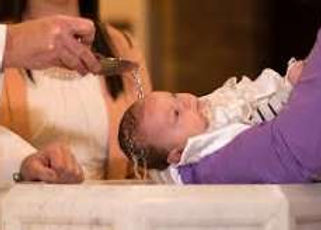
A general definition for the word baptism is “a rite of washing with water as a sign of religious purification and consecration.” This rite was practiced frequently in the Old Testament. It signified purity or cleansing from sin and devotion to God. Since baptism was first instituted in the Old Testament many have practiced it as a tradition yet have not fully understood its significance and meaning.
In the New Testament, the significance of baptism is seen more clearly. John the Baptist was sent by God to spread the news of the coming Messiah—Jesus Christ. John was directed by God (John 1:33) to baptize those who accepted his message. John’s baptizing is called “a baptism of repentance for the forgiveness of sins.” Mark 1:4 (NIV).
Those baptized by John acknowledged their sins and professed their faith that through the coming Messiah they would be forgiven. Baptism then is significant in that it represents the forgiveness and cleansing from sin that comes through faith in the Lord Jesus Christ.
For Roman Catholics it is a public act of initiation into the Church and the beginning of a process of participating in the activity of the Faith community we call parish. Therefore it is a public ceremony which involves the participation of the community.
Booking: Please contact the parish office (0429334648) at least ONE MONTH before the baptism.
Baptism Ceremony: The baptism Ceremony takes place on the 2nd and 4th Sunday of the month in St. Patrick's church at 4.00p.m.
Baptisms outside these times will only be performed in emergency or exceptional circumstances.
Baptism Preparation:
On the Tuesday evening before the baptism takes place, a meeting will take place in St. Patrick's parish house.. This meeting will be for parents and godparents of candidates who are due to be baptized. At this meeting each family will be given an outline of the service, instructed on the meaning of the sacrament. The meetings will be led by Deacon Brendan or one of the priests and members of the baptismal team.
Weddings

Weddings are made by individual arrangement.
Contact the Parochial House and speak to one of the priests.
Please allow at least three (3) months notice
"The matrimonial covenant, by which a man and a woman establish between themselves a partnership of the whole of life, is by its nature ordered toward the good of the spouses and the procreation and education of offspring; this covenant between baptized persons has been raised by Christ the Lord to the dignity of a sacrament." (Catechism of the Catholic Church)
The Parish follows the Common Policy for Marriage for the Archdiocese of Armagh. Those wishing to Marry must contact the Parish at least three months in advance.
As part of the preparation for this lifetime commitment the couple must complete a pre-marriage course. ACCORD is the Agency recognised by the Church for this purpose. Please click here for a link to their website which will give details of upcoming courses in your region. http://www.accord.ie
In preparation for marriage Couples will be asked to provide a Recently issued copy of their Baptismal and Confirmation Certificates. Please call the Church where you were Baptized and/or Confirmed and ask that a newly issued copy be made available to you (There may be a fee for this service). If the Church where you were baptized or Confirmed no longer exists you may call the Diocese in which the Church was located to ascertain where the records are kept, in this case, please speak to one of our priests. If your sacraments were administered at St. Patrick's we will have the record and you do not need to obtain a copy.
Under Family Law Act, 1995, section 33, three months notification must be given to the Registrar for the district in which the marriage is to take place. It is the responsibility of intending couples to give this notification in good time.
One of the best websites for preparing for Marriage in the Church is www.gettingmarried.ie
Marriage is the sacrament in which a baptised man and woman vow to belong to each other in a permanent, exclusive, sexual partnership of loving and mutual care, concern and shared responsibility, in the hope of having children and bringing up a family. The celebrants of the sacrament of Marriage are the bride and bridegroom. However, for a valid celebration of the sacrament by one of her members, the Church , nowadays, normally requires that a priest and two others be present as witnesses to the vows.
The mystery of the Church signified and brought about in this sacrament is the marriage bond: that sharing in the priesthood of Christ by which the two partners are permanently consecrated to each other and to their children. The mystery of grace that is signified and brought about in the sacrament of Marriage is a sharing in the Spirit by which the two partners grow in mutual love and are enabled to face together the problems of married life to make of their family an image of the Church united in charity. This sacrament is a sign of the union in love between Christ and his bride, the Church (cf Eph 5).
Marriage cannot normally be repeated while both partners are alive; for their consecration to each other is permanent. A civil divorce does not dissolve the valid marriage of baptised persons.
Please click here for information on the Armagh Diocesean Marriage Tribunal
Funerals

On behalf of the parish can we express our sympathy to you who mourn the death of your loved one
To assist the bereaved and the Parish Funeral Team will help the family to plan the funeral rites and your participation in it,
When we meet to prepare for your loved one’s funeral we will be happy to discuss with you any of the details of the funeral prayers and the Requiem Mass.
To help you prepare what follows is an order of Service / Mass
-
Entrance Procession and Hymn
-
Opening Words of Welcome from the Celebrant, followed by a family eulogy (if they wish) and/or bringing of personal symbols to the altar with family a member explaining significance (if they wish)
-
First Reading – you can choose from the resources in this section
-
Psalm (Usually sung)
-
Second Reading. again you can choose from the resources in this section
-
Alleluia Verse (Usually sung)
-
Gospel – Normally the gospel is chosen to compliment the readings and music you have chosen
-
Prayer of the Faithful (immediately after the homily) These should be adapted to the circumstances of the deceased and made personal. One, two or more readers may read the prayers. Samples of these are in the booklet.
-
Offertory Procession (Two or more persons may take the gifts of bread and wine)
-
Communion Reflection (any suitable prayer, poem or prose which is fitting, or which the deceased used as meditation during life, may be recited immediately after Communion.)
To those who are bereaved
Death is always a sad occurrence. To lose a spouse, parent, family member or close friend is surely one of the most painful experiences we must endure in life. While nothing at this time can remove the pain of loss, the Funeral Mass has a clear message of hope. The Readings, Psalms and Communion Reflections that follow all convey compassion and hope.
The presence of people at a time of family bereavement may also be a wonderful source of strength. It is the local community speaking not in words but by their very presence.
The Priests of the Parish are most anxious to be a source of support and strength at this time and will be here to help in the months and years ahead. People often suffer in isolation. The bereavement process for some is very prolonged, but for all it is intense. Our prayers are never unmindful of your grief. We would feel privileged to be of help in any way and at any time during your time of grief.
For the Funeral, there are a number of ceremonies to help the bereaved gradually console in a gentle and spiritual way.
At a time, which is generally sad and emotional for the family and friends of the deceased, we are ready and anxious to assist in any way possible. Arrangements for Church Liturgies are made with the priests of the Parish.
The Rite of Christian burial normally consists of
(1) Reception of Remains in Church,
(2) Funeral Liturgy in Mass or Funeral Liturgy without Mass,
(3) Final commendation and burial.
Some General Points
The following points may help summarise what is needed:
… This first thing is not to worry about the arrangements. All the material above may seem rather detailed, but in practice the priest, the Parish Funeral Team and undertaker will guide you through it. Don’t feel you have to do everything. The Parish Funeral Team are there to look after you.
… After a death has occurred people sometimes feel under pressure to have the Mass and burial as soon as possible. If possible, avoid the temptation to rush things.
… You may wish to involve family members or other chief mourners in the celebrations in a special way. Give them some of the simpler tasks: placing symbols on the Table of Life, bringing up the gifts at Mass. You can also involve a lot of people in a more informal way by gathering for prayer (Vigil for the Deceased) and reflection at the funeral home or at home. This is an ideal time for favourite songs, prayers, poems and stories.
… The reading of any texts in the church itself is more demanding and is best given to someone who will not be too distraught, preferably an experienced church reader.
… Music can add greatly to the meaningful celebration of a funeral. In the church itself, use only religious music that has been written for the liturgy. We will be able to contact those who have the ministry of music in the parish. Suggested hymns are available in Parish Resources for Funerals booklet.
… You might find it helpful to have other significant moments in the weeks and months ahead when you remember your loved one in a special way: a month’s mind Mass, visits to the cemetery, the annual parish Mass for the dead in November, putting up a headstone, and the first anniversary. These could be moments when you gather with just a few people to pray and to remember.
When Someone You Love Has Died: Preparing For A Funeral
The trauma of losing someone close is very deep and leaves us disorientated. Depending on the circumstances, the death of a loved one can leave us feeling numb, shocked, exhausted, angry, relieved, depressed, or a combination of any of these. Trying to organise a funeral in the middle of all this is not easy. Thankfully there are people around to help: your local priest, your local undertaker, friends and neighbours. The Priests, Funeral ministry teams and undertakers have long experience of helping people when a death occurs and will give you the advice and support that you need.
What follows is intended as a brief guide to help you choose what is best for the funeral of a loved one. First, there is a brief description of the principal rites at the time of a funeral, and then some general advice about planning.
Remembering the Dead: the Wake or Vigil
Funerals are a time for remembering. We can feel an urge to tell the story of the one who has passed away. Stories about the good times and the bad surface and want to be told. We reminisce. This is something natural and healthy and deserves a bit of time and space. The Irish tradition of the wake has allowed for this, but this custom hasn’t survived everywhere.
A rite called the ‘Vigil for the Deceased’ has been put together for use in Ireland. It is not well known but it offers an opportunity for family and friends to gather for prayer in the presence of the body of the person who has died. This could take place at home, in a funeral parlour or in the hospital or nursing home mortuary chapel. It includes readings and prayers that evoke our hope in the resurrection as well as giving voice to the pain of what has happened. It is a moment of entrusting ourselves and our loved one who has died to the care of Christ himself. Sometimes, if people wish, it could include the rosary or a portion of it. All the prayers can be led by a layperson or a priest. At the end of the prayers, people might want to voice some personal remembrances of the person who has died, perhaps to read a poem or any other text that was dear to the deceased, tell some stories, or to hear some favourite music. This kind of remembrance takes place more easily and naturally at a small gathering such as this than at the funeral Mass, which tends to be more public and formal.
The Reception of the Remains
An important moment in the Funeral celebration is when the body of the person who has died is received or welcomed back into their parish church where they worshiped with the rest of the Christian community. It is a kind of homecoming. Relatives, friends, and other members of the community gather either inside or outside the church. When the chief mourners arrive with the coffin at the door of the church, they are greeted by the priest or lay minister who conducts the service. The coffin is sprinkled with holy water as a reminder of Baptism: the person who has died was already united at Baptism with the death of Christ in order that he or she would rise again to new life.
The Pall
If the deceased was a member of a particular association or group, the coffin may have had a flag or other insignia on it when it was being brought to the church; these are normally now removed – we are all one in Baptism and thus no individual is singled out by special insignia on the coffin once it is inside the church. There are however special signs of honour associated with being a Christian that you may wish to be placed on the coffin. The first of these is the pall. This is a large white cloth that is draped over the coffin. It recalls the white garment (sometimes called the Christening shawl) worn by each newly baptised person as a sign of their Christian dignity. It can be placed on the coffin by family, friends, or another member of the community.
Christian Symbols
The coffin is then led in procession to the sanctuary of the church. When everyone has taken their place you may wish to have the Christian life of your loved one further honoured by having Christian symbols placed on the coffin. Examples of these would be a cross, a Bible, rosary beads or a prayer book. This introductory part of the service concludes with a short prayer. At this point the family are given the opportunity to give a family eulogy and/or bring personal symbols from the life of the deceased. All then sit for the Liturgy of the Word.
The Liturgy of the Word
The Liturgy of the Word is the central part of this service and is composed mainly of readings from the Bible. Although the books of the Bible are many centuries old and not always easy to understand, we believe that they are inspired by God and that God can really speak to us through these ancient texts. Above all, these writings help us to know Christ himself, who passed through death into new life. At a critical moment like this, when all our certainties seem to fall away, we can derive great inner strength when we hear the story and message of Jesus himself, who triumphed over death. If you wish, the priest (or the Funeral Team member) will help you choose readings that seem particularly suitable to your situation.
Who Should Read the Readings?
If you really want people to hear the message of the readings which you have chosen, you need to have someone who is experienced at reading in public. Inexperienced readers sometimes think they can be clearly heard and understood. It is best to pick someone who already reads at Mass, a friend, or a relative. One piece of advice: a person who was very close to the one who has died may be put under quite a strain, trying to read in public, they may, however, have a strong need and desire to participate and we are there to support, help and advise.
After the readings are concluded and the priest explains them briefly, everybody stands to pray together for the person who has died and for those who mourn and are in pain.
Baptisms